
If you’ve ever opened your trailer after a drive and found your cargo shifted, tilted, or sitting nowhere near where you left it, you already know why tie-down systems matter.
Straps help. But straps are only as useful as the anchor points holding them.
That’s where the E-track vs L-track conversation comes in. Both systems are designed to keep cargo secure inside a trailer, but they don’t work exactly the same way. One gives you heavy-duty flexibility across longer sections of the trailer. The other offers more precise attachment points in a compact design.
So, which one belongs in your trailer?
The answer depends less on which system is “better” and more on what you’re hauling.
E-Track vs. L-Track: What’s the Biggest Difference?
Both systems are designed to create a secure trailer tie down system, but they approach the job differently.
Instead of thinking about one as an upgrade over the other, it helps to think about the type of cargo you carry and how often your trailer setup changes.
E-Track Is Designed for Maximum Versatility
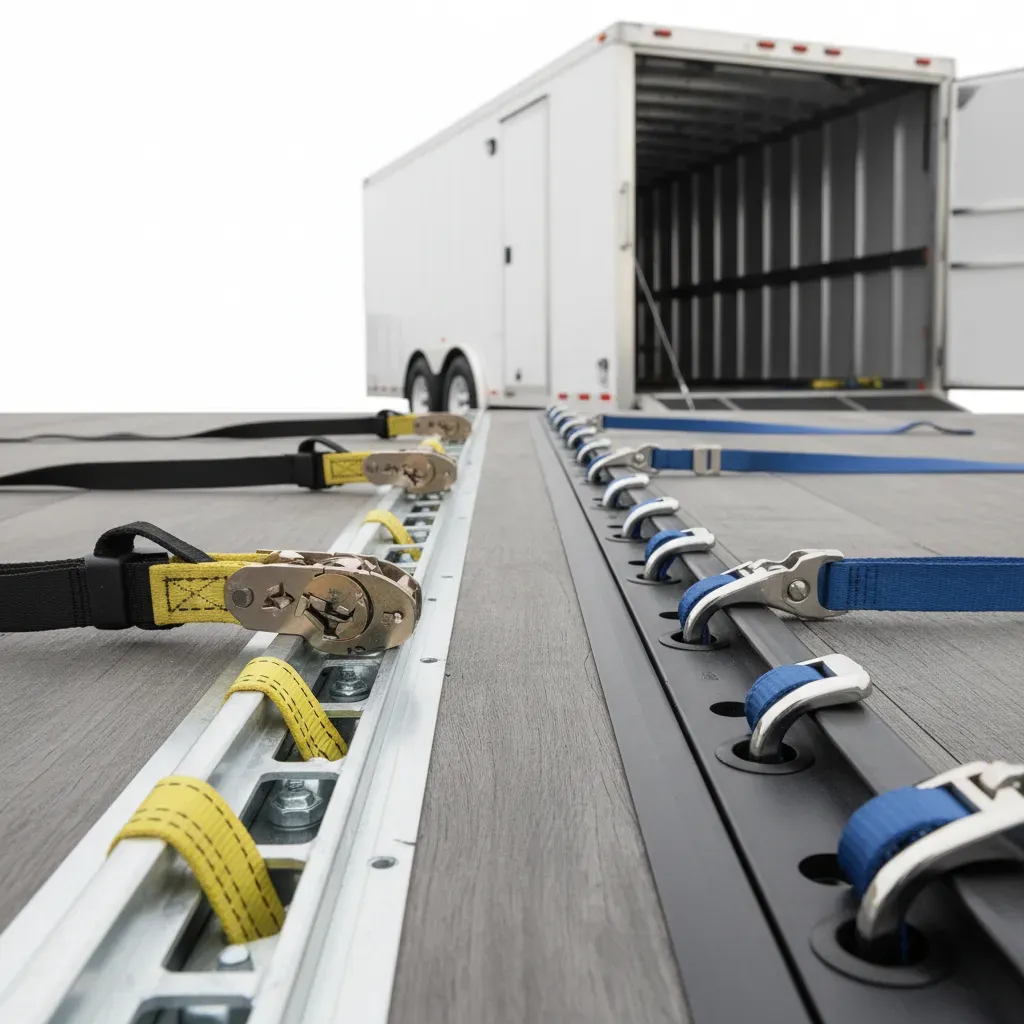
E-track consists of long steel rails with evenly spaced slots that run along the trailer floor, walls, or both.
Because there are so many attachment points, it’s easy to reposition straps, hooks, shelves, or storage accessories as your cargo changes. If your trailer carries different loads from one trip to the next, E-track gives you the flexibility to secure almost anything without installing new hardware.
That adaptability is one reason it’s one of the most popular choices for enclosed trailer tie downs.
L-Track Focuses on Precision
L-track uses a narrower aluminum rail with circular anchor points spaced along its length.
Instead of providing continuous attachment options, it offers strategically placed connection points that work well for lighter cargo, motorcycles, recreational equipment, and custom trailer interiors.
Because it has a slimmer profile, L-track is often chosen when maintaining a clean appearance or maximizing floor space is a priority.
Installation Looks Different Too
Both systems require secure mounting, but the installation process isn’t exactly the same.
E-track is typically installed in longer sections that distribute weight across a larger area of the trailer. L-track, on the other hand, is often installed exactly where anchor points are needed, making it a popular option for customized layouts.
The right installation depends on the trailer’s construction and the weight of the cargo you’ll secure regularly.
Which System Works Better for Different Types of Cargo?
Imagine two trailer owners.
One transports landscaping equipment during the week, furniture on weekends, and occasionally uses the trailer for moving household items.
The other hauls the same motorcycle every weekend to local events.
Would they choose the same tie-down system?
Probably not.
The first owner benefits from a flexible cargo trailer track system that adapts to constantly changing loads. That’s where E-track often shines.
The second owner may only need a few well-positioned anchor points designed specifically around one piece of equipment. L-track often fits that situation well because it creates a cleaner, more tailored setup.
Neither choice is wrong. They’re simply solving different problems.
Think About How Your Trailer Will Change Over Time
One thing many buyers don’t consider is that trailers rarely stay exactly the same.
Businesses grow.
Equipment changes.
Storage systems get added.
What starts as an empty cargo trailer may eventually include shelving, cabinets, workbenches, or specialty equipment.
If you expect your hauling needs to evolve, choosing a tie-down system that can evolve with them is just as important as choosing the right trailer itself.
Before You Install a Tie-Down System
Choosing between E-track and L-track becomes much easier when you think about how you’ll use the trailer every week instead of focusing only on today’s cargo.
Consider How Often Your Cargo Changes
If every trip looks different, a flexible system that allows you to move straps and accessories quickly can save time and make loading much easier.
Think About Future Accessories
Many tie-down systems support more than straps. Shelves, baskets, hooks, tool holders, and storage accessories can all become useful additions as your trailer setup grows.
Match the System to the Weight You Carry
Not every load places the same demands on a trailer. Choosing a system designed for the type and weight of your equipment helps improve both safety and long-term durability.
The Best Tie-Down System Is the One That Fits Your Workflow
There’s no universal winner in the E-track vs L-track debate.
If flexibility and changing cargo are part of your routine, E-track often offers more versatility. If you want a cleaner layout with strategically placed anchor points, L-track may be the better fit.
The right choice comes down to one simple question:
How do you actually use your trailer?
Answer that honestly, and the better system usually becomes obvious.
Wagoneer Trailers: Building Trailers That ya Work the Way You Do
At Wagoneer Trailers, we know that a trailer is more than a place to carry cargo—it’s part of the way you work. That’s why we help customers across Georgia customize enclosed trailers with practical features that improve organization, efficiency, and security.
Whether you’re planning a flexible cargo trailer track system, adding enclosed trailer tie downs, or building a completely customized trailer, we’ll help you choose the options that make sense for your hauling needs today and as they grow in the future.
LET’S BUILD A TRAILER THAT KEEPS YOUR CARGO SECURE

Cameron Fitzgerald
Owner of Wagoneer Trailers since 2019. Combines 9+ years of transportation industry expertise with a focus on customizable trailer solutions and customer-centric financing.
