
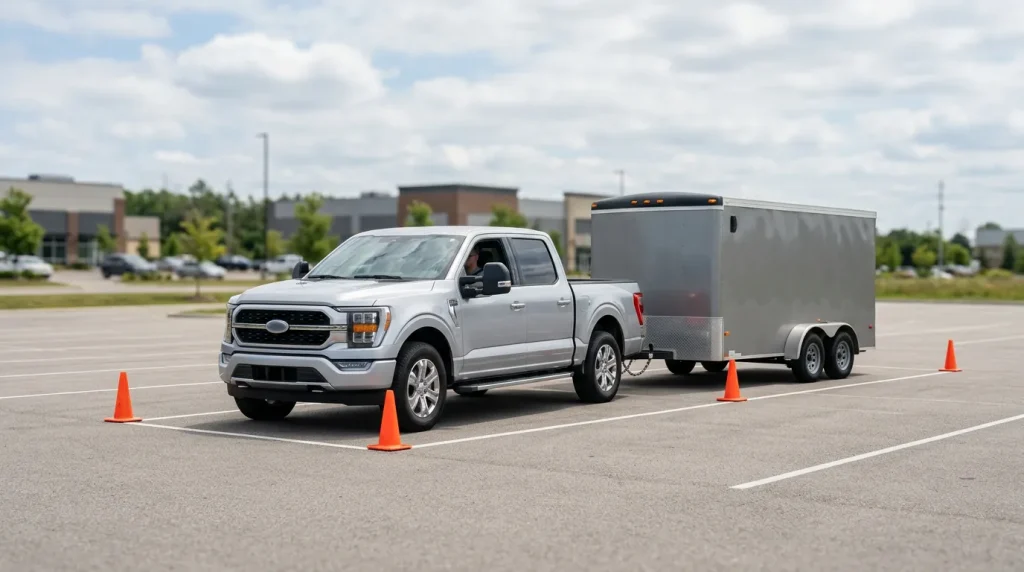
You’ve arrived. The parking spot is right there, there’s enough room, and everything seems simple enough—until you put the vehicle in reverse and the trailer starts moving in the opposite direction from where you expected.
That’s the awkward part of learning how to back up a trailer. Your instincts are built around steering a vehicle forward, so reversing with a trailer can feel backward at first.
The good news is that backing gets much easier once you stop trying to make one perfect move. The goal is to work slowly, make small corrections, and give yourself enough room to adjust before the trailer gets too far off line.
Set Yourself Up Before You Reverse
A good backing job often starts before the vehicle moves.
Take a moment to look at the space, check for curbs, posts, low obstacles, uneven ground, or anything that might disappear from view once you’re in the driver’s seat. If you’re unsure about clearance, get out and look.
Your starting position matters too. A better approach angle gives you more room to guide the trailer gradually instead of making sharp corrections halfway through the maneuver.
One of the simplest trailer backing tips is also one of the most useful: don’t make the job harder before it starts.
A Step-by-Step Backing Sequence
Once you understand the basic steering relationship, using the same sequence each time can make backing feel much more predictable.
Step 1: Check the Space
Look at the entire path before reversing. Identify where the trailer needs to end up and note anything that could limit your turning room.
Step 2: Choose Your Starting Position
Give yourself as much usable space as possible. Starting too close to the parking area or at a difficult angle can force bigger corrections later.
Step 3: Start Straight and Reverse Slowly
Begin at a controlled pace while watching both mirrors. Small steering inputs are easier to manage than large ones, especially when you’re still learning how quickly the trailer responds.
Step 4: Create the Angle
Gradually steer so the rear of the trailer begins moving toward the space. Once it starts heading in the right direction, stop adding more angle than you need.
Step 5: Follow the Trailer
Adjust the tow vehicle so it begins following the trailer into position. Keep checking both mirrors instead of focusing on only one side.
Step 6: Straighten the Setup
As the trailer lines up, make smaller corrections until the tow vehicle and trailer are closer to straight again.
Step 7: Reset When Needed
If the angle gets away from you, stop. Pull forward, straighten out, and try again. Resetting is often faster and safer than trying to rescue a poor approach.
Why Small Corrections Work Better
Overcorrecting is one of the biggest reasons backing starts to feel chaotic.
You turn the wheel sharply, the trailer reacts, and then you have to make an equally large correction in the opposite direction. Before long, you’re chasing the trailer instead of guiding it.
Small movements give you more control because they give the trailer time to respond. Make one adjustment, watch what happens, then decide whether you need another.
This is especially helpful when backing up a utility trailer, enclosed trailer, or any setup where visibility and trailer length affect how quickly the angle changes.
Practice in the Right Order
If you’re still learning, don’t start with the tightest parking space you can find.
Begin by practicing in an open, permitted area. Learn to reverse in a straight line first. Once that feels comfortable, practice gentle turns and wider spaces before moving on to tighter angles.
Over time, you’ll start recognizing how much steering input your trailer needs and how quickly it reacts. That familiarity is what makes backing feel easier.
Also keep in mind that different trailers behave differently. Length, load, tow vehicle, and overall setup can all change the response, so give yourself time to adjust when switching trailers.
The Goal Isn’t a Perfect One-Try Back-In
There’s no rule saying you need to get into space on the first try.
What matters is control.
Getting better at how to back up a trailer means checking the space, reversing slowly, watching both mirrors, making smaller corrections, and resetting when the approach stops working.
If a maneuver that once took five corrections eventually takes two, that’s progress.
And that’s really what confidence looks like when backing a trailer: not perfection, just a process you understand.
Find the Right Trailer With Wagoneer Trailers
At Wagoneer Trailers, we help customers across Georgia find enclosed trailers for equipment, business cargo, recreation, and everyday hauling. With customizable options, flexible financing, and direct delivery, we can help you choose a setup that fits the way you tow and use your trailer.
FIND YOUR ENCLOSED TRAILER HERE!

Cameron Fitzgerald
Owner of Wagoneer Trailers since 2019. Combines 9+ years of transportation industry expertise with a focus on customizable trailer solutions and customer-centric financing.
