
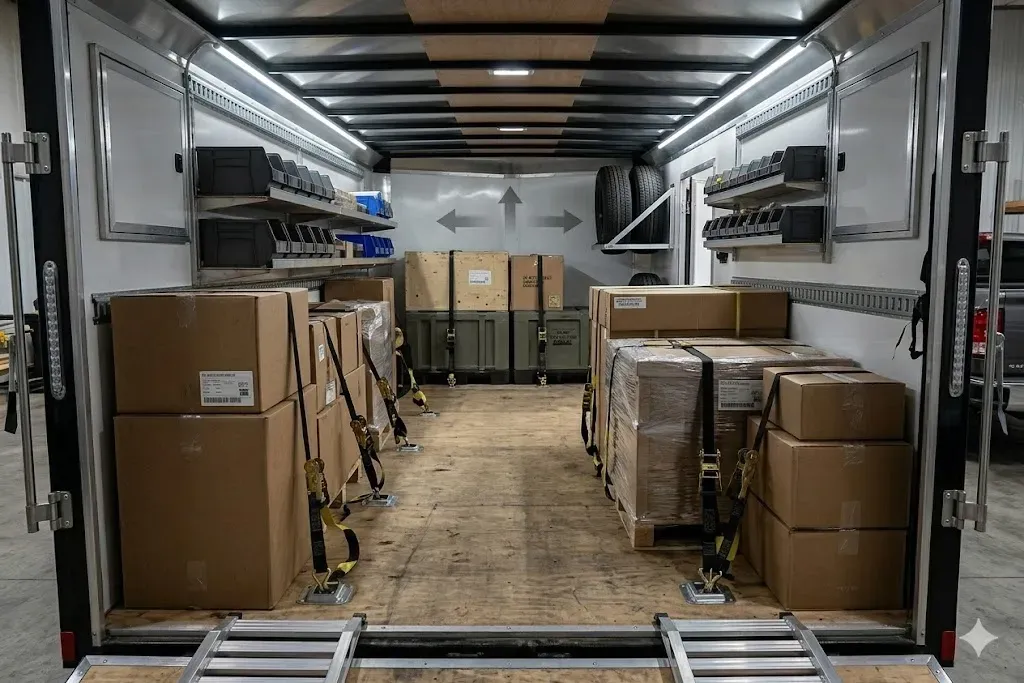
Loading a trailer involves more than fitting everything inside and closing the doors. The position, height, and security of your cargo directly affect how the trailer responds when you accelerate, brake, turn, or change lanes.
A poorly loaded trailer may sway, pull to one side, place too much pressure on the hitch, or increase the risk of cargo damage. It can also cause uneven tire wear and make the tow vehicle harder to control.
Knowing how to load a trailer properly helps create a safer and more predictable towing experience. Whether you are hauling tools, equipment, building materials, inventory, or recreational vehicles, the same basic principles apply: stay within capacity, distribute weight correctly, keep heavy items low, and prevent the cargo from moving.
Why Proper Trailer Loading Matters
The weight inside a trailer is constantly affected by movement.
Acceleration pushes cargo toward the rear. Braking sends force toward the front. Curves, lane changes, and uneven roads create side-to-side pressure. If cargo is poorly positioned or not secured, these forces can change the trailer’s balance while you are driving.
Proper trailer loading can help:
-
Reduce trailer sway
-
Improve steering response
-
Support more controlled braking
-
Protect the trailer’s tires and suspension
-
Prevent cargo from shifting or falling
-
Reduce unnecessary stress on the hitch
-
Keep the trailer within its rated capacity
A trailer that feels stable while parked may behave very differently at highway speed. That is why the loading process must account for both weight distribution and movement.
Step 1: Check the Trailer’s Weight Ratings
Before loading anything, determine how much weight the trailer can safely carry.
The trailer’s identification plate or manufacturer information should list important ratings, including:
-
GVWR: Gross Vehicle Weight Rating
-
GAWR: Gross Axle Weight Rating
-
Empty or curb weight
-
Tire load ratings
-
Maximum cargo or payload capacity
GVWR is the maximum allowable weight of the loaded trailer. It includes the trailer itself, cargo, installed equipment, tools, batteries, water, fuel, and any other items carried inside or on the trailer.
A basic way to estimate available payload is:
GVWR − Empty Trailer Weight = Estimated Payload Capacity
For example, a trailer with a 7,000-pound GVWR and a 2,200-pound empty weight may have approximately 4,800 pounds of payload capacity.
However, do not rely on that calculation alone. Axle, tire, wheel, coupler, hitch, and tow-vehicle limits may further restrict how much weight can be carried.
Never exceed the lowest-rated component in the towing system.
Step 2: Use the 60/40 Guideline as a Starting Point
For many conventional bumper-pull trailers, a common starting point is to position approximately 60% of the cargo weight in the front half of the trailer and 40% in the rear half.
The front of the trailer is the end closest to the tow vehicle.
This slightly forward-biased arrangement helps place enough downward force on the hitch to improve stability. Loading too much weight behind the axles can make the trailer more likely to sway or fishtail. U-Haul’s trailering guidance also recommends placing about 60% of the cargo weight in the front half as a starting point.
The 60/40 guideline is not a substitute for checking tongue weight. Trailer design, axle location, cargo shape, and installed equipment all affect the final balance.
Use it to begin positioning the load, then measure or verify the actual tongue weight before towing.
Step 3: Place Heavy Cargo Low and Near the Axles
Load the heaviest items first.
Whenever possible, place them:
-
On or close to the trailer floor
-
Near the axle area
-
Slightly forward of the axle centerline
-
Away from the rear doors
-
Against stable surfaces or approved cargo stops
Keeping heavy cargo low reduces the trailer’s center of gravity. A lower center of gravity generally helps the trailer remain more stable during turns and emergency maneuvers.
Avoid placing heavy items on shelves or stacking them on top of lighter cargo. Even when the total trailer weight is within capacity, high-mounted weight can make the trailer feel top-heavy.
Do not place every heavy item at the very front wall, either. Excessive forward weight can overload the tongue, hitch, or rear axle of the tow vehicle. The goal is a controlled forward bias—not concentrating the full load on the trailer tongue.
Step 4: Balance the Load From Side to Side
Front-to-back balance receives plenty of attention, but side-to-side balance is equally important.
Cargo should be centered across the width of the trailer whenever possible. Avoid placing several heavy items along one wall while leaving the other side mostly empty.
Uneven side loading may:
-
Place more pressure on one tire or axle end
-
Cause uneven tire wear
-
Make the trailer lean
-
Affect suspension performance
-
Reduce stability during turns
-
Make the trailer pull toward one side
If two heavy items are similar in size, place one on each side of the trailer. When one large item must sit off-center, use other cargo to help offset its weight without exceeding any rating.
Shelving, cabinets, generators, water tanks, batteries, and permanently installed equipment must also be included in the side-to-side calculation. These items continue affecting trailer balance even when the cargo area appears empty.
Step 5: Verify the Tongue Weight
Tongue weight is the downward force the trailer places on the hitch ball.
For many conventional trailers, tongue weight commonly falls around 10% to 15% of the total loaded trailer weight. The correct percentage can vary based on the trailer design and manufacturer instructions. Ford also identifies approximately 10% to 15% as a general range while advising owners not to exceed the tow vehicle or hitch limits.
A trailer weighing 6,000 pounds when fully loaded may therefore require approximately 600 to 900 pounds of tongue weight, depending on its design and specifications.
Too little tongue weight can contribute to sway. Too much can overload the hitch, reduce weight on the tow vehicle’s front axle, and affect steering or braking.
Tongue weight also counts against the tow vehicle’s available payload. Passengers, tools, equipment, and cargo in the tow vehicle reduce the remaining capacity available for the trailer’s tongue weight.
Use a tongue-weight scale, suitable vehicle scale, or another manufacturer-approved method to verify the load. Do not estimate tongue weight based only on how much the tow vehicle’s rear suspension drops.
Gooseneck and fifth-wheel trailers use different hitch-weight ranges and loading considerations. Follow the trailer and tow-vehicle manufacturers’ instructions for those configurations.
Step 6: Secure Every Item Against Movement
Once the cargo is positioned correctly, secure it before moving the trailer.
A well-balanced load can become unsafe if it shifts several inches during a hard stop or sharp turn.
Depending on the cargo, securement equipment may include:
-
Ratchet straps
-
Chains and binders
-
E-track fittings
-
D-rings
-
Wheel chocks
-
Wheel nets
-
Load bars
-
Cargo nets
-
Blocking and bracing
-
Approved shelving restraints
Use tie-down points that are rated for the load. Do not attach heavy cargo to decorative trim, lightweight shelving, door hardware, or another component not designed as an anchor.
Whenever practical, secure heavy equipment in more than one direction. Prevent it from moving:
-
Forward during braking
-
Rearward during acceleration
-
Sideways during turns
-
Upward when traveling over bumps
Check that straps are not cut, frayed, twisted, or rubbing against sharp edges. Use edge protectors where necessary and confirm that hooks are fully engaged.
Commercial haulers may also be subject to specific cargo-securement requirements. FMCSA rules require applicable commercial cargo to be loaded and secured so it does not leak, spill, blow, fall, or shift in a way that affects vehicle stability.
Step 7: Check the Tow Vehicle and Hitch Limits
The trailer is only one part of the towing system.
Confirm that the loaded combination remains within the ratings for:
-
Tow-vehicle towing capacity
-
Tow-vehicle GVWR
-
Gross Combination Weight Rating
-
Front and rear axle ratings
-
Receiver hitch
-
Ball mount
-
Hitch ball
-
Coupler
-
Weight-distribution system
-
Tires and wheels
A trailer may be under its own GVWR while still exceeding the tow vehicle’s payload, rear axle rating, or hitch capacity.
The weight of passengers, cargo in the tow vehicle, aftermarket equipment, and trailer tongue weight all affect the tow vehicle’s available capacity.
Manufacturer towing guides commonly caution that added passengers, equipment, and cargo reduce the amount a vehicle can tow or carry.
When the actual loaded weights are uncertain, use a certified vehicle scale to weigh the tow vehicle and trailer.
Step 8: Complete a Pre-Trip Inspection
Loading is not finished until the complete trailer has been inspected.
Before leaving, confirm that:
-
The coupler is fully seated and latched
-
The hitch pin and safety clip are installed
-
Safety chains are crossed and securely attached
-
The breakaway cable is connected correctly
-
The trailer jack is fully raised
-
The electrical plug is secure
-
Running lights, turn signals, and brake lights work
-
The trailer brakes respond correctly
-
Tires are properly inflated
-
Wheels and lug nuts show no visible issues
-
Doors, ramps, and latches are secured
-
Cargo straps remain tight
-
No item can contact the doors or wiring
-
The load remains level and balanced
Walk around the trailer again after the first few miles. Straps may loosen as cargo settles, especially when hauling boxed materials, equipment with tires, or items stacked on pallets.
Check the load again during fuel, meal, and rest stops.
How Different Cargo Types Affect Loading
The safest loading method depends partly on what the trailer carries.
Tools and Construction Equipment
Place dense tools, compressors, generators, and machinery low and near the axles. Use cabinets, shelving restraints, and floor-mounted tie-downs to prevent smaller items from becoming loose during travel.
ATVs, UTVs, and Motorcycles
Position vehicles so their combined weight creates the correct tongue weight. Use appropriate wheel chocks and secure each vehicle at approved attachment points.
Do not rely on the parking brake alone.
Cars and Heavy Equipment
Vehicle position can significantly change tongue weight. Moving a vehicle forward or backward by a small distance may noticeably affect trailer balance.
Use equipment-rated straps, chains, binders, and anchor points. Follow the securement instructions for the specific vehicle or machine.
Boxes and Household Items
Place dense boxes on the floor and lighter items on top. Fill empty spaces to reduce movement, but do not use fragile items as structural supports.
Secure the full load so boxes cannot slide toward the doors.
Liquid Tanks
Liquids can surge as the trailer accelerates, stops, and turns. Secure tanks firmly and account for the changing forces created by liquid movement.
Partially filled tanks may behave differently from full or empty tanks, so follow the tank and trailer manufacturer’s recommendations.
Common Trailer Loading Mistakes
Loading Too Much Weight Behind the Axles
Rear-heavy loading can reduce tongue weight and increase the risk of trailer sway.
Assuming 60/40 Automatically Means Correct Tongue Weight
The 60/40 arrangement is a starting point. Always verify the final tongue weight and component ratings.
Ignoring Side-to-Side Balance
A trailer can have acceptable tongue weight and still be unsafe because one side is carrying substantially more weight than the other.
Stacking Heavy Cargo Too High
High-mounted weight raises the center of gravity and can make the trailer less stable in turns.
Using Underrated Tie-Downs
Straps and anchor points must be appropriate for the cargo. A tie-down that works for boxes may not be suitable for a vehicle or piece of machinery.
Forgetting Permanent Equipment
Shelving, cabinets, generators, batteries, water tanks, spare tires, and installed equipment all count toward the trailer’s total weight and balance.
Checking Capacity but Not Actual Weight
Estimated cargo weights can be inaccurate. When operating close to capacity, weigh the loaded trailer rather than relying on assumptions.
Proper Trailer Loading for Frequent Hauling
If the trailer carries similar cargo each week, create a repeatable loading system.
Mark the preferred positions for equipment on the floor. Assign storage areas for frequently used tools. Install approved D-rings, E-track, wheel chocks, shelving, or partitions where they support consistent weight distribution.
A planned interior makes it easier to:
-
Keep heavy equipment near the correct position
-
Maintain side-to-side balance
-
Find suitable tie-down points
-
Prevent loose tools from moving
-
Repeat a safe configuration for every trip
Recheck the loaded weight whenever equipment, shelving, tanks, or other permanent features are added. An interior upgrade can reduce the available payload and change the trailer’s balance.
Choose a Trailer That Supports the Way You Haul
Proper loading begins with the right trailer.
Axle placement, payload capacity, floor construction, anchor points, interior height, shelving, and storage layout all affect how easily cargo can be balanced and secured.
Wagoneer Trailers offers enclosed cargo trailers, car haulers, concession trailers, and custom configurations for customers throughout Georgia and beyond. The team can help you compare trailer sizes, weight ratings, tie-down options, and interior features based on what you plan to carry.
Explore available trailers or contact Wagoneer Trailers in Valdosta, Georgia, to discuss a trailer designed around your hauling needs.
Frequently Asked Questions About Loading a Trailer
Should 60% of the Weight Always Be in Front?
The 60/40 guideline is a useful starting point for many conventional trailers, but it is not universal. Follow the trailer manufacturer’s instructions and verify the actual tongue weight before towing.
Where Should the Heaviest Items Go?
Place the heaviest items low, near the axle area, and usually slightly forward of the axle centerline. The exact position should produce the appropriate tongue weight without overloading the hitch or tow vehicle.
Can Too Much Tongue Weight Be Dangerous?
Yes. Excessive tongue weight can overload the hitch or the tow vehicle’s rear axle. It may also reduce weight on the front wheels and affect steering, braking, and headlight aim.
How Do I Know Whether My Trailer Is Overloaded?
Compare the trailer’s actual loaded weight with its GVWR, axle ratings, and tire ratings. The most dependable approach is to weigh the loaded trailer at a certified scale.
What Should I Do if the Trailer Starts Swaying?
Reduce speed gradually while keeping the steering steady. Avoid sudden steering movements or hard acceleration. Follow the tow vehicle and trailer manufacturers’ instructions for sway recovery, and inspect the load distribution before continuing.
How Often Should Cargo Straps Be Checked?
Inspect them before departure, again after the cargo has had time to settle, and during stops throughout the trip. Commercial operations may have additional inspection requirements.

Cameron Fitzgerald
Owner of Wagoneer Trailers since 2019. Combines 9+ years of transportation industry expertise with a focus on customizable trailer solutions and customer-centric financing.
