
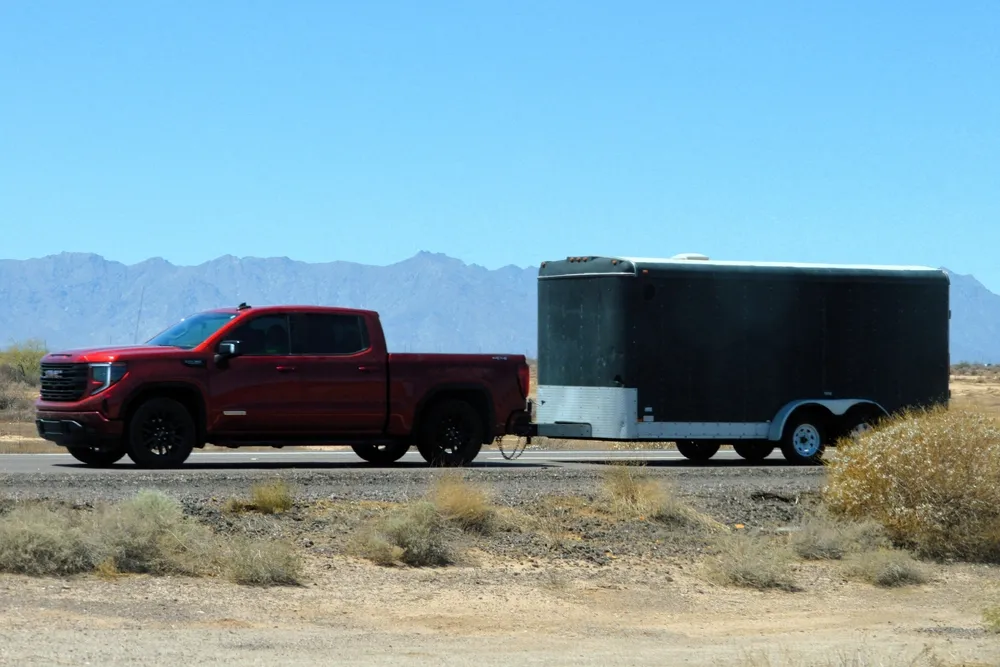
Towing a trailer adds length, weight, and responsibility to your drive. Acceleration changes. Braking distances increase. Turns require more space. And backing up can feel unfamiliar at first.
The key to safe trailer hauling isn’t complicated—it’s preparation, smooth control, and understanding how your trailer responds in real-world conditions. Whether you’re hauling equipment, vehicles, or setting up for commercial use, these practical tips can help you stay confident on the road.
Tip #1: Secure the Hitch the Right Way
Safe towing starts at the connection point.
Properly hooking up trailer hitch components means confirming the hitch ball matches the coupler size, the latch locks fully, and the safety pin is in place. Cross safety chains under the tongue to create a cradle in case of disconnection, and attach the breakaway cable separately.
Test all lighting before moving. Brake lights and turn signals aren’t secondary details — they’re part of overall road safety. A stable connection eliminates unnecessary movement before you even start driving.
Tip #2: Load for Stability, Not Just Capacity
How you distribute weight determines how the trailer tracks behind your vehicle.
The best way to load a trailer places heavier cargo toward the front half while maintaining roughly ten to fifteen percent tongue weight. Keep weight low and centered over the axle whenever possible. Secure all cargo tightly to prevent shifting during turns or stops.
Rear-heavy loads often create sway at highway speeds. Balanced loads improve steering response, braking control, and overall stability.
If the trailer feels unstable, reassess weight placement before adjusting driving technique.
Tip #3: Adjust for Increased Stopping Distance
Stopping distance expands the moment you attach a trailer.
One of the most practical tips for driving with a trailer is allowing additional space between you and the vehicle ahead. Gradual braking reduces forward push from the trailer and lowers stress on both braking systems.
If your trailer has electric brakes, a properly calibrated good trailer brake controller keeps the trailer and tow vehicle slowing at the same rate. That synchronization prevents jerking and improves downhill control.
Smooth deceleration creates steadier towing.
Tip #4: Drive Smoothly and Take Wider Turns
A trailer doesn’t follow your exact tire path. It tracks inside your vehicle’s turn.
That means you’ll need wider entry angles when turning in parking lots, fuel stations, and tight intersections. Rushed steering corrections often create instability, especially at moderate speeds.
Wind gusts or passing trucks may shift the trailer slightly. Maintain a steady grip on the wheel and ease off the accelerator gradually instead of reacting abruptly.
Controlled inputs maintain alignment.
Tip #5: Back Up Slowly and Use Small Adjustments
Backing up becomes manageable once you understand how small movements affect direction.
Place your hand at the bottom of the steering wheel. Move your hand left to guide the trailer left, and right to guide it right. This reduces confusion during adjustments.
Among the most effective tips for backing up a trailer is moving at a crawl. Slow movement gives you time to correct angles before they become sharp. If the trailer begins to fold too tightly, pull forward, straighten, and try again. Resetting is part of controlled maneuvering, not a mistake.
Practice in an open area until corrections feel natural.
Tip #6: Plan Ahead in Tight Spaces
Positioning matters before you enter confined areas.
These practical driving-a-trailer tips focus on foresight:
- Plan your exit before pulling in
- Allow extra clearance on turns
- Monitor overhead obstacles
- Avoid rushed positioning
Backing in first often makes departure simpler. Thinking two moves ahead reduces unnecessary repositioning.
Wagoneer Trailers: Designed for Controlled Commercial Performance
Driving technique plays a major role in safe towing, but trailer design matters just as much. Frame strength, axle placement, braking systems, and weight balance influence how stable a trailer feels under load.
At Wagoneer Trailers, we build and sell enclosed trailers engineered for dependable commercial and personal use across Georgia. From car haulers to concession trailers and fully customized builds, each unit is designed with durability and structural balance in mind.
When your trailer is built for consistent weight distribution and road stability, maneuvering becomes more predictable. That translates into smoother hauling, safer braking, and greater control during tight positioning.
If you’re evaluating enclosed trailers that support reliable performance and commercial demands, connect with our team.

Cameron Fitzgerald
Owner of Wagoneer Trailers since 2019. Combines 9+ years of transportation industry expertise with a focus on customizable trailer solutions and customer-centric financing.
