
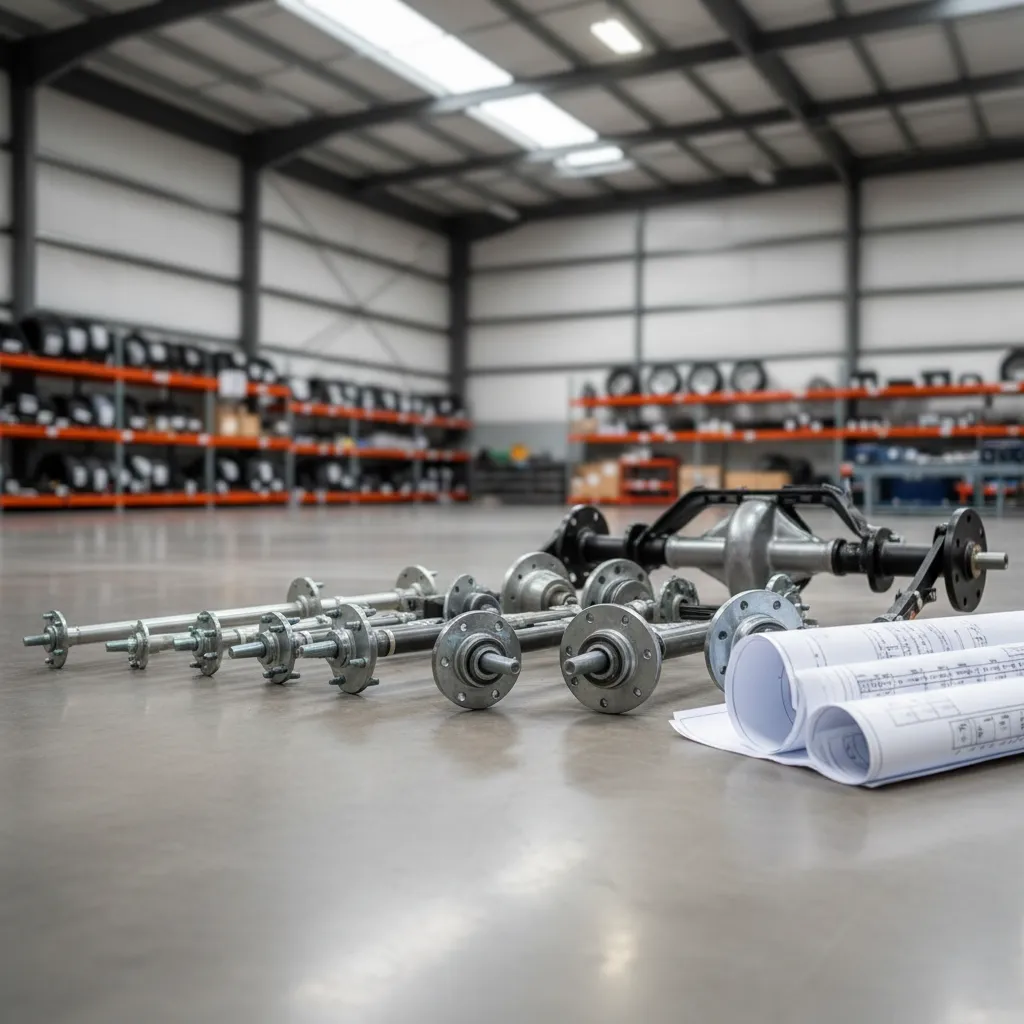
Choosing a trailer axle requires more than matching the width of the existing axle or counting the wheel lugs. The axle must have the correct capacity, measurements, suspension configuration, brakes, hubs, bearings, and wheel compatibility for the trailer.
This distinction matters because trailer axle size can refer to several different specifications. Some people use the term to describe axle capacity, while others mean hub-face width, spring-center spacing, tube dimensions, or bolt pattern.
These measurements are related, but they are not interchangeable. A wide axle is not necessarily a high-capacity axle, and two axles with the same weight rating may have different dimensions.
This guide explains how to read a trailer axle label, understand common axle capacities, take the measurements needed for a replacement, and avoid common ordering mistakes.
What Does Trailer Axle Size Mean?
There is no single measurement called axle size. Selecting an axle requires reviewing several specifications together.
|
Axle Specification |
What It Describes |
Why It Matters |
|---|---|---|
|
Rated capacity |
The weight the axle is designed to support |
Must be appropriate for the trailer’s design and intended load |
|
Hub face |
Distance between the wheel-mounting surfaces |
Determines wheel position and fender clearance |
|
Spring center |
Distance between the centers of the spring seats |
Must correspond with the suspension and trailer frame |
|
Overhang |
Distance from the spring center to the hub face |
Affects axle stress and overall fit |
|
Bolt pattern |
Number and spacing of wheel studs |
Determines wheel compatibility |
|
Brake size and type |
Dimensions and operating system of the brakes |
Must match the hubs, wheels, controller, and trailer requirements |
|
Spindle and bearings |
Components supporting the hub |
Determine hub and bearing compatibility |
|
Axle profile |
Straight, drop, overslung, or underslung arrangement |
Affects deck height and ground clearance |
|
Suspension type |
Leaf spring or torsion |
Affects mounting, ride characteristics, and replacement requirements |
A complete trailer axle size chart should keep capacity and physical dimensions separate. Hub-face width may help identify whether an axle fits the trailer, but it does not establish the axle’s weight rating.
Axle Capacity, GAWR, and Trailer GVWR
Axle capacity is only one part of the trailer’s overall weight rating.
What Is GAWR?
Gross Axle Weight Rating, or GAWR, is the load-carrying capacity assigned by the vehicle manufacturer to a single axle system, measured where the tires contact the ground. The axle system includes more than the axle tube alone. Tires, wheels, brakes, suspension components, and other related parts must also support the assigned rating.
This means the component supplier’s axle rating should not be treated as the trailer’s complete GAWR by itself.
What Is GVWR?
Gross Vehicle Weight Rating, or GVWR, is the maximum loaded weight assigned to the complete trailer by its manufacturer. It includes:
-
The empty trailer
-
Cargo
-
Installed equipment
-
Batteries
-
Water or fuel
-
Tools and supplies
-
Accessories added to the trailer
The sum of the axle capacities does not automatically equal the trailer’s GVWR. Tongue weight, frame design, suspension, tires, wheels, coupler, brakes, and other components also affect the rating.
A Larger Axle Does Not Automatically Increase GVWR
Replacing an axle with one that has a higher component rating does not automatically increase the trailer’s certified GVWR.
For example, installing two 7,000-pound axles on a trailer originally rated for 10,000 pounds does not automatically turn it into a 14,000-pound trailer. The frame, coupler, tires, wheels, suspension, brakes, and certification must all support the higher rating.
Use the trailer certification label and manufacturer documentation as the primary references for GVWR and GAWR.
Read the Axle Label Before Measuring
Before ordering a replacement axle, look for the original axle label.
Depending on the manufacturer and axle type, the label may provide:
-
Manufacturer name
-
Axle model
-
Rated capacity
-
Serial number
-
Part number
-
Hub-face measurement
-
Spring-center measurement
-
Outside-bracket measurement
-
Torsion start angle
-
Brake or adjustment information
Dexter axle labels, for example, identify the axle model and capacity separately from hub face, spring center, outside bracket, and other configuration details. The serial number may also be etched into the axle tube when the original label is missing or unreadable.
Take a clear photo of the label before cleaning, repairing, or removing the axle. A serial number may allow the axle manufacturer to retrieve the original build specifications.
Where to Look for the Label
Check:
-
The rear-facing side of the axle tube
-
Near the center of the axle
-
Around the spring seats
-
Near the torsion mounting brackets
-
Inside the trailer’s original documentation
If the label is missing, record every physical measurement and component number before ordering parts.
Common Trailer Axle Capacity Ranges
Trailer axles are manufactured in many capacities. Dexter, for example, offers leaf-spring axles across a broad range, including light-duty products from approximately 2,000 to 8,000 pounds and heavier axle families above those ratings.
Frequently encountered capacities include:
|
Common Rated Capacity |
Important Reminder |
|
2,000 pounds |
Confirm hub type, wheel size, bearings, and whether brakes are installed |
|
3,500 pounds |
Do not assume every 3,500-pound axle has the same width or bolt pattern |
|
5,200 pounds |
Verify spindle, hub, brake, wheel, and suspension compatibility |
|
6,000 pounds |
May resemble other axle families but use different components |
|
7,000 pounds |
Confirm wheel, tire, brake, and spring ratings |
|
8,000 pounds and above |
Often requires application-specific running gear and mounting details |
These ratings should not be paired with universal hub-face or spring-center measurements. Axles with the same capacity can be built in different widths and configurations.
Use the axle label or manufacturer records to identify capacity. Use physical measurements to determine fit.
How to Measure a Trailer Axle
Measure the existing axle only after safely supporting the trailer according to the trailer and axle manufacturers’ procedures.
For the most accurate results:
-
Park on a firm, level surface.
-
Prevent the trailer from moving.
-
Use appropriately rated lifting and support equipment.
-
Do not work beneath a trailer supported only by a jack.
-
Take each measurement more than once.
-
Record measurements in inches.
-
Photograph the axle and suspension before disassembly.
Whenever possible, measure the original axle while the hubs, suspension, and mounting points are still intact.
How to Measure Hub Face
Hub face is the distance from one wheel-mounting surface to the corresponding wheel-mounting surface on the opposite side.
This is the flat surface where the wheel contacts the hub—not the end of the spindle, dust cap, brake drum, or axle tube.
To measure hub face:
-
Remove the wheels when necessary to access the mounting surfaces.
-
Place the end of the tape measure against one wheel-mounting face.
-
Extend it straight across the axle.
-
Measure to the opposite wheel-mounting face.
-
Record the result as the hub-face measurement.
Dexter identifies hub face as the distance between the two wheel-mounting surfaces. It influences axle width, wheel alignment, and clearance.
Do Not Measure Overall Width Instead
Overall axle width may include:
-
Spindle ends
-
Dust caps
-
Hub protrusion
-
Brake components
-
Other hardware
That number is not necessarily the hub-face measurement required when ordering an axle.
How to Measure Spring Center
Spring center is measured from the center of one spring seat to the center of the spring seat on the opposite side.
Do not measure from:
-
Inside edge to inside edge
-
Outside edge to outside edge
-
Frame rail to frame rail
-
U-bolt to U-bolt without identifying the actual centerline
To measure spring center:
-
Locate the center of each spring seat.
-
Mark the centerline when necessary.
-
Measure directly from one centerline to the other.
-
Record the result as the spring-center measurement.
The spring-center measurement must correspond with the trailer’s suspension and frame arrangement. An incorrect measurement can prevent proper mounting or create poor load distribution.
Worn, damaged, or previously relocated spring seats may not provide reliable measurements. Compare the physical measurement with the axle label and original trailer specifications whenever possible.
Understanding Axle Overhang
Axle overhang is the distance between the suspension mounting area and the wheel-mounting surface.
On a centered, symmetrical axle, the approximate overhang on each side can be calculated as:
(Hub Face − Spring Center) ÷ 2
For example, if the hub face is 89 inches and the spring center is 74 inches:
(89 − 74) ÷ 2 = 7.5 inches of overhang per side
Overhang affects axle stress and fit. It should not be changed casually to move the wheels outward or create additional frame clearance.
Axle manufacturers account for tube size, spindle design, capacity, and overhang when specifying an axle. Dexter notes that overhang influences axle stress and that axle configuration must be compatible with the trailer and suspension layout.
Check Wheel and Fender Clearance
A correct hub-face measurement helps position the wheels, but additional measurements are still necessary.
Check:
-
Tire width
-
Wheel offset
-
Wheel backspacing
-
Fender width
-
Inner wall clearance
-
Frame clearance
-
Brake-drum clearance
-
Suspension travel
-
Space between tandem tires
The same axle can position the tire differently when a wheel with another offset or backspacing is installed.
Do not order a wider axle solely to correct a wheel-clearance problem. Confirm whether the real issue is the axle width, wheel specification, tire size, fender position, or trailer frame.
Identify the Wheel Bolt Pattern
The bolt pattern must match the trailer wheels.
Common configurations include:
-
Four lug
-
Five lug
-
Six lug
-
Eight lug
The number of lugs does not establish axle capacity by itself. Different axle and hub families can use similar bolt patterns.
Record:
-
Number of studs
-
Bolt-circle diameter
-
Stud diameter
-
Wheel pilot or center-bore requirement
-
Lug-nut style
-
Wheel load rating
Replacing only the axle may not require new wheels, but the new hubs must remain compatible with the existing wheel pattern and load rating.
Check the Hubs, Bearings, and Spindles
Axles with similar dimensions can use different hubs, bearings, seals, and spindles.
Before ordering, identify:
-
Inner bearing number
-
Outer bearing number
-
Grease-seal number
-
Spindle profile
-
Hub or hub-and-drum part number
-
Wheel-stud size
-
Lubrication system
-
Brake-flange pattern
Bearing numbers are usually stamped into the bearing components. Clean the parts carefully and record the complete identification number.
Do not select a replacement hub based only on bolt pattern. The bearings, seal, spindle, brake size, and load rating must also be compatible.
Confirm the Brake Configuration
A replacement axle must match the trailer’s brake system or be correctly configured for the intended system.
Check:
-
Idler or brake axle
-
Electric or hydraulic brakes
-
Drum or disc brakes
-
Brake diameter and width
-
Brake-flange pattern
-
Parking-brake provisions
-
Brake-controller compatibility
-
Wiring or hydraulic-line routing
Some lighter axles may be configured without brakes, while heavier applications may require brakes based on trailer design, operating location, and applicable regulations.
Do not assume that two axles with the same capacity use the same brake assemblies.
Straight Axles and Drop Axles
A straight axle positions the spindle close to the axle tube’s centerline. A drop axle positions the spindle above the lowest part of the axle assembly, which can lower the trailer deck.
A drop axle may help provide:
-
Lower deck height
-
Easier loading
-
A lower center of gravity
-
Reduced ramp angle
However, it may also reduce ground clearance.
Do not replace a straight axle with a drop axle—or the reverse—without checking:
-
Frame clearance
-
Suspension travel
-
Tire clearance
-
Fender position
-
Coupler height
-
Trailer attitude
-
Ground clearance
-
Manufacturer specifications
Dexter offers both straight and drop-spindle configurations in several axle families, but availability and compatibility depend on capacity and axle design.
Overslung and Underslung Leaf-Spring Axles
With an overslung configuration, the springs are positioned above the axle. With an underslung configuration, the springs are below it.
Changing the spring position affects:
-
Deck height
-
Ground clearance
-
Suspension geometry
-
Stability
-
Brake-wire routing
-
Tire and fender clearance
Do not relocate spring seats or “flip” an axle simply to raise or lower the trailer without qualified guidance.
Trailer axles are often manufactured with a designed upward camber. Rotating the axle incorrectly can affect tire alignment and loading behavior.
Leaf-Spring Axles vs. Torsion Axles
Leaf-Spring Axles
Leaf-spring systems use springs, hangers, shackles, equalizers, and related mounting components.
Potential advantages include:
-
Familiar construction
-
Replaceable suspension components
-
Wide availability
-
Straightforward service access
-
Options for single- and tandem-axle trailers
A replacement leaf-spring axle must match the hub-face and spring-center measurements along with the required capacity and component specifications.
Torsion Axles
Torsion axles use rubber cords inside the axle assembly to provide independent suspension movement. They mount directly to the trailer frame through brackets rather than conventional leaf springs.
Potential advantages may include:
-
Independent wheel movement
-
Fewer external suspension components
-
Lower mounting options
-
Smoother or quieter operation in some applications
Torsion axle replacement commonly requires the outside-bracket measurement, start angle, bracket style, capacity, hub face, and mounting-hole details. Dexter describes torsion products as independent-suspension systems and identifies start angle and bracket configuration as important fit considerations.
Do not order a torsion axle using leaf-spring axle measurements alone.
Single-Axle and Tandem-Axle Configurations
A single-axle trailer uses one axle assembly. A tandem-axle trailer uses two axles positioned close together.
Tandem axles can distribute the trailer’s load across more tires and suspension components, but adding another axle does not eliminate the need to calculate the complete trailer rating.
For a tandem replacement, also record:
-
Distance between axle centers
-
Hanger spacing
-
Equalizer dimensions
-
Spring length
-
Shackle length
-
Suspension-kit specifications
-
Tire clearance between the axles
-
Brake configuration on each axle
Both axles should be compatible with the suspension system and trailer design. Replacing only one axle with a different capacity, camber, tube size, or brake configuration may cause uneven load sharing or handling problems.
Trailer Axle Replacement Checklist
Record the following before ordering a replacement:
Identification
-
Axle manufacturer
-
Model number
-
Serial number
-
Part number
-
Rated capacity
-
Trailer GVWR
-
Trailer GAWR
Dimensions
-
Hub face
-
Spring center
-
Overhang
-
Axle-center spacing on tandem trailers
-
Outside-bracket measurement for torsion axles
-
Torsion start angle
-
Frame width
-
Fender and tire clearance
Suspension
-
Leaf spring or torsion
-
Overslung or underslung
-
Double-eye or slipper spring
-
Spring length
-
Hanger spacing
-
Mounting-bracket pattern
Wheels and Hubs
-
Bolt pattern
-
Wheel size
-
Wheel offset
-
Wheel load rating
-
Tire size
-
Tire load rating
-
Inner bearing
-
Outer bearing
-
Grease seal
-
Hub or drum number
Brakes
-
Brake or idler axle
-
Electric or hydraulic
-
Drum or disc
-
Brake dimensions
-
Brake-flange pattern
-
Controller or actuator compatibility
Axle Profile
-
Straight or drop
-
Tube shape and dimensions
-
Spindle type
-
Lubrication system
-
Camber orientation
Providing all this information is more reliable than requesting an axle by trailer length or axle width alone.
Common Axle Measuring and Ordering Mistakes
Using Width to Estimate Capacity
Axle width does not reliably indicate capacity. Check the axle label, serial number, manufacturer documentation, and component specifications.
Measuring From the Ends of the Hubs
Hub face is measured between the wheel-mounting surfaces—not between dust caps, spindle ends, or outer hub edges.
Measuring Spring Seats Edge to Edge
Spring center is a center-to-center measurement.
Ordering by Bolt Pattern Alone
Matching the wheels does not confirm that the spindle, bearings, brakes, capacity, or axle dimensions are correct.
Ignoring Wheel Offset
A matching hub face can still create clearance issues when the replacement wheels have a different offset or backspacing.
Assuming Higher Capacity Raises the Trailer Rating
A higher-capacity axle does not automatically increase GVWR or payload.
Forgetting the Brakes
A physically compatible axle may still use the wrong brake size, flange pattern, wiring, or hydraulic configuration.
Mixing Tandem Axles
Different axle capacities, dimensions, suspension setups, or brake systems may prevent the tandem assembly from sharing the load correctly.
Copying Measurements From a Similar Trailer
Two trailers with the same body dimensions may use different frames, axles, fenders, wheels, and suspension layouts.
Measure the actual trailer and verify its original specifications.
Trailer Axle and Tire Maintenance
Axle capacity and measurements are important, but ongoing maintenance also affects performance.
Check Tire Pressure Cold
Use the cold inflation pressure specified by the trailer manufacturer on its certification or tire-information label. Do not automatically use the maximum pressure molded into the tire sidewall as the trailer’s recommended setting.
NHTSA advises using the manufacturer-specified cold inflation pressure and checking pressure before driving or after the tires have been stationary long enough to cool.
Inspect for Uneven Tire Wear
Uneven wear may indicate:
-
Incorrect inflation
-
Overloading
-
Worn suspension components
-
Bent running gear
-
Incorrect alignment
-
Damaged bearings
-
Improper axle fit
Do not replace tires repeatedly without investigating the underlying cause.
Compare Hub Conditions
After towing, cautiously check for differences between hubs without touching potentially hot components directly.
A hub that is noticeably hotter than the others, leaking lubricant, noisy, or loose should be inspected according to the axle manufacturer’s service procedures.
There is no single universal hub-temperature threshold that applies to every axle, brake, bearing, road condition, and measurement method.
Inspect Suspension Components
Check:
-
Springs
-
Hangers
-
Shackles
-
Equalizers
-
U-bolts
-
Torsion brackets
-
Welds
-
Brake wiring
-
Hydraulic lines
Loose or worn suspension parts can affect alignment and load distribution even when the axle itself is undamaged.
Start With the Right Axle Configuration
Axle selection affects trailer capacity, wheel clearance, deck height, braking, suspension performance, and long-term tire wear. The best choice begins with accurate measurements and the trailer manufacturer’s ratings—not an assumption based on width, tube diameter, or lug count.
Wagoneer Trailers offers enclosed, concession, equipment, and custom trailer configurations for customers throughout Georgia and Florida. Available specifications and upgrades include leaf-spring axles, electric brakes, multiple wheel and tire configurations, and axle options selected around the trailer’s intended use.
Explore available trailers or contact Wagoneer Trailers in Valdosta, Georgia, to discuss the capacity, dimensions, and equipment needed for your next trailer.
Frequently Asked Questions About Trailer Axle Sizes
Can I Determine Axle Capacity From the Tube Diameter?
Tube dimensions may offer clues about an axle family, but they do not provide enough information to confirm capacity. Axles with similar tubes may use different spindles, hubs, brakes, materials, or rated configurations.
Use the axle label, serial number, manufacturer records, and complete component specifications.
Can I Determine Axle Capacity From the Number of Wheel Lugs?
No. Bolt pattern alone does not establish axle capacity. Different hubs and axle families can share similar lug patterns.
Are All 3,500-Pound Trailer Axles the Same Width?
No. Axles with the same capacity can be manufactured with different hub-face and spring-center dimensions.
Can I Install a Wider Axle?
Only when the wider axle is compatible with the frame, suspension, fenders, wheels, tires, brakes, and trailer manufacturer’s requirements. A wider axle changes wheel position and may increase overhang and axle stress.
Can I Move the Spring Seats?
Spring-seat relocation requires accurate alignment and appropriate welding procedures. Incorrect placement can cause poor tracking, tire wear, suspension binding, or structural failure.
Have axle modifications evaluated and completed by a qualified trailer or axle professional.
Can I Replace a Leaf-Spring Axle With a Torsion Axle?
This is generally a trailer-design modification rather than a direct axle replacement. The frame mounting, suspension loads, ride height, wheel position, and reinforcement requirements must be evaluated.
Does a Tandem Trailer’s Capacity Equal Both Axle Ratings Added Together?
Not necessarily. The complete trailer GVWR may be lower than the combined axle-component ratings because the frame, tires, wheels, suspension, brakes, coupler, or other components have lower limits.
Where Can I Find the Axle Serial Number?
Look for a label or etched number on the axle tube, often near the center or on the rear-facing side. The exact location varies by manufacturer.
Should I Replace Both Axles on a Tandem Trailer?
That depends on their condition and compatibility. If the remaining axle differs in capacity, dimensions, camber, brakes, or suspension configuration, replacing both may be appropriate. Have the complete running gear inspected before ordering.

Cameron Fitzgerald
Owner of Wagoneer Trailers since 2019. Combines 9+ years of transportation industry expertise with a focus on customizable trailer solutions and customer-centric financing.
