
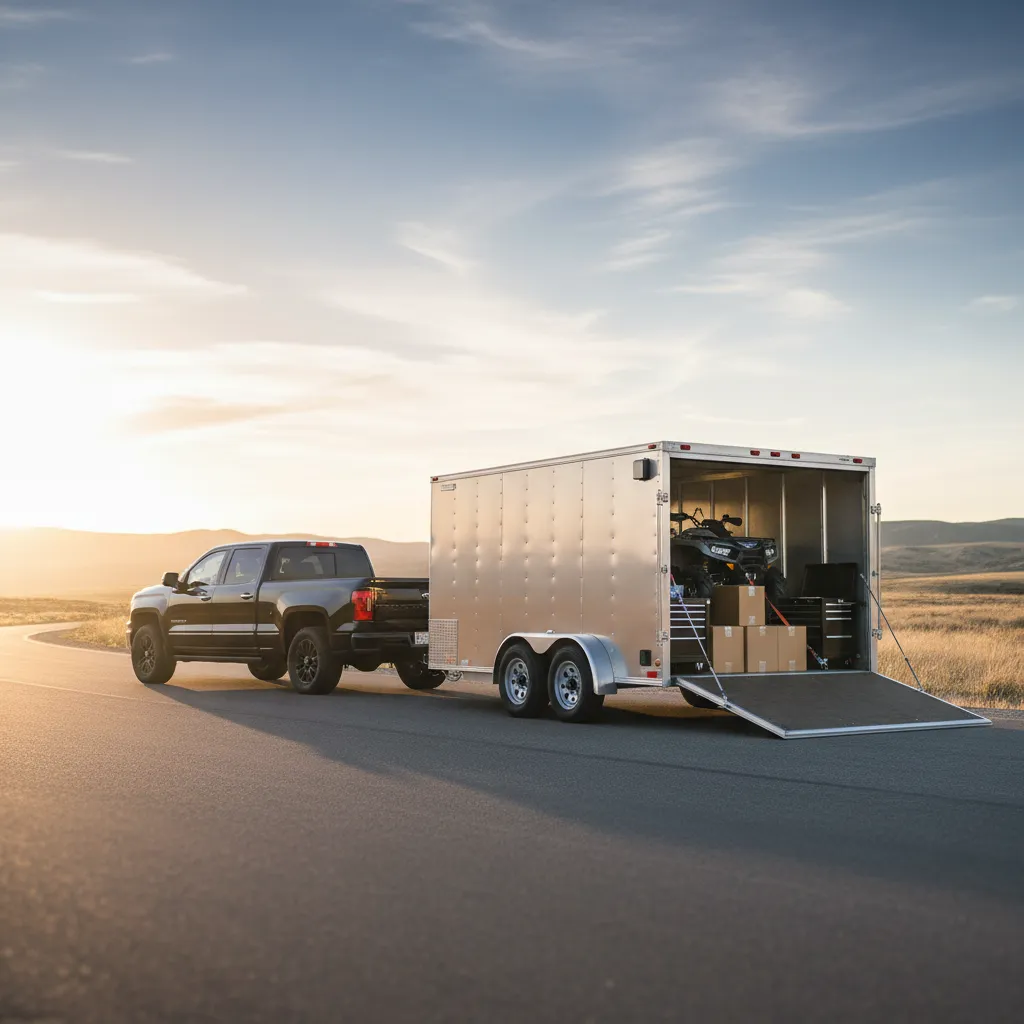
A trailer can be under its maximum weight and still tow badly.
That’s the part that catches people off guard.
You can carefully check how much cargo you’re carrying, close the doors, hitch up, and still end up with a trailer that feels nervous behind the tow vehicle. The problem may not be how much you loaded. It may be where you put it.
Good trailer weight distribution is about creating balance without making the trailer too light or too heavy at the hitch. And fortunately, there are some clues that can tell you when your loading strategy needs another look.
Clue #1: Most of the Weight Is Hanging Out in the Back
Loading from the rear makes this an easy mistake to make.
You roll in the equipment, stack a few heavier items nearby, fill the remaining spaces with tools and supplies, and everything fits beautifully.
Except “everything fits” and “everything is balanced” aren’t the same thing.
Too much weight toward the rear can reduce trailer tongue weight, which may contribute to instability and sway. On the other hand, loading excessively toward the front can put too much weight on the hitch and tow vehicle.
Cargo placement needs to work with the trailer’s specifications, not simply whichever arrangement leaves the most convenient walking path.
Clue #2: The Tow Vehicle Looks Different Once You Hitch Up
Before pulling onto the road, take a look at the whole setup.
Not just the trailer.
If the rear of the tow vehicle appears excessively compressed after the trailer is connected, or the overall combination doesn’t sit as expected, don’t ignore it just because everything is technically attached.
That visual change can be a reason to stop and check the load, tongue weight, hitch setup, and applicable ratings before leaving.
This is also why learning how to load a trailer involves more than memorizing where the heaviest item should go. Your cargo, trailer, hitch, and tow vehicle have to work together.
Clue #3: The Trailer Feels Like It’s Making Decisions for You
You shouldn’t spend a normal drive constantly correcting what the trailer is doing behind you.
If it begins moving noticeably from side to side, feels unusually unstable, or becomes harder to control, treat that behavior seriously.
Weight placement is one factor that can contribute to trailer sway, although speed, tire condition and pressure, wind, hitch configuration, and other factors can also play a role.
Good trailer sway prevention starts before the vehicle moves. Load the trailer according to the manufacturer’s requirements, secure cargo so it cannot shift, verify the towing setup, and stay within all applicable weight ratings.
If the trailer starts swaying on the road, don’t treat it as something you should simply “drive through.”
Clue #4: Your Cargo Can Change Positions Mid-Trip
You might have loaded everything perfectly.
Then the trailer hits the road.
A toolbox slides. Equipment moves against a wall. Boxes shift toward the rear. Suddenly, the weight isn’t distributed exactly the way it was when you closed the doors.
That’s why cargo securement is part of weight distribution too.
Heavy items need appropriate tie-downs and secure positioning so they remain where you intended throughout the trip. It’s particularly important when transporting equipment with wheels or anything capable of sliding across the trailer floor.
A balanced trailer at departure should still be balanced when you arrive.
The Number You Shouldn’t Guess: Tongue Weight
The trailer may look balanced and still need verification.
Tongue weight is the downward force the trailer places on the hitch, and the appropriate amount depends on the trailer and towing setup. Rather than estimating it by looking at how the vehicle sits, use the manufacturer’s specifications and an appropriate method of measurement.
This is one area where “looks about right” isn’t a particularly useful measurement.
If you change the load significantly, it may also change the tongue weight. Moving a heavy machine, adding equipment, or rearranging cargo can alter the balance enough that it’s worth checking again.
A Well-Loaded Trailer Should Feel Uneventful
That’s really the goal.
You shouldn’t be thinking about trailer weight distribution every second you’re towing. The trailer should follow predictably, the cargo should remain secured, and the entire combination should stay within the ratings established for the trailer, hitch, tires, axles, and tow vehicle.
Getting there starts before the trip.
Know what you’re hauling. Pay attention to where the weight goes. Secure it properly. Verify the important numbers instead of guessing.
Because when trailer loading is done well, the most noticeable thing about it is usually how little you notice it at all.
Haul With Confidence With Wagoneer Trailers
At Wagoneer Trailers, we help customers across Georgia choose enclosed trailers based on what they haul, how often they tow, and what setup fits their vehicle and daily needs.
From trailer size and axle configuration to customization options, financing, and direct delivery, we make it easier to find a trailer that feels practical from day one.
GET IN TOUCH WITH US TODAY!

Cameron Fitzgerald
Owner of Wagoneer Trailers since 2019. Combines 9+ years of transportation industry expertise with a focus on customizable trailer solutions and customer-centric financing.
